
Remote Tunnel
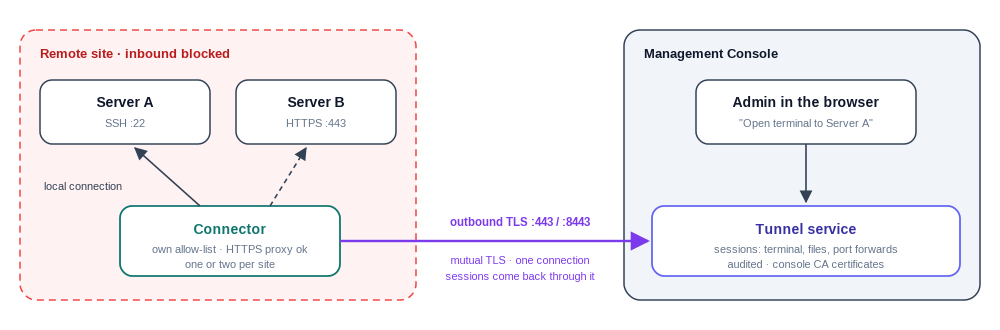
Connect your Management Console with servers and applications on separate private networks, such as a data centre with 10 servers and a branch with 50. It works even when the console has only a private address and no public URL. No inbound firewall ports are needed where avoidable, and every session is authorised and audited.
Pick the one your network already allows.
Agent Tunnel (default)
A small connector inside the remote network dials out to the console over TLS 443 with mutual TLS. Sessions come back through that connection. No inbound rules, works through HTTP proxies.
Direct
The networks are already linked (MPLS, ExpressRoute, Direct Connect, peering, your own VPN). No tunnel; the console reaches the hosts as they are.
Published gateway
The console stays private. Publish only its tunnel service on one HTTPS port (firewall or DMZ, TCP passthrough); every site's connectors dial that address.
Bastion and proxy hops
Reuse the jump hosts and proxies you already have: SSH bastions (ProxyJump), SOCKS5 or HTTP CONNECT, chained after any method.
Reverse tunnel
Servers the console reaches but that cannot reach it get the console on their own 127.0.0.1, over an SSH connection the console keeps open. Nothing to install, no inbound port.
Sites and high availability
Group each remote network as a Site with its subnets. Run two connectors per Site; if one stops, the other takes over. Servers in the Site can reach the console through the connector.
Outbound only.
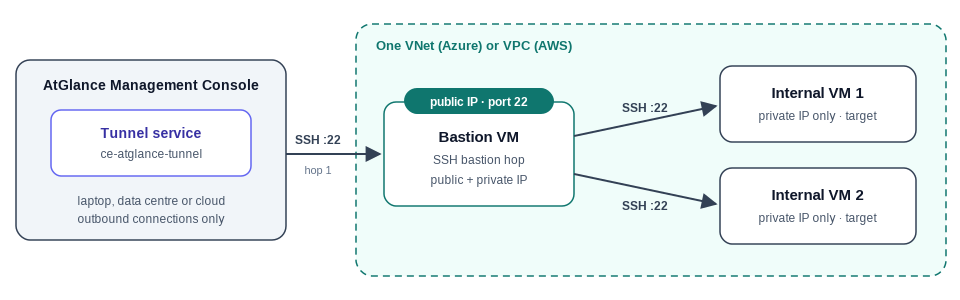
Reach private VMs through a bastion.
One VM with a public IP acts as the SSH jump host; the other VMs in the same VNet or VPC keep private IPs only. The console connects outbound, nothing is installed on the VMs, and only port 22 of the bastion is open, to your console's address.
Azure
- One VNet and subnet; a bastion VM with a static public IP; the internal VMs without one.
- NSG: TCP 22 from your console's public IP to the bastion, and TCP 22 inside the VNet.
- A NAT gateway if the internal VMs need the Internet.
- User: the admin user you chose (for example
adminuser).
AWS
- One VPC; the bastion in a public subnet with an Elastic IP; the internal instances in a private subnet.
- Security groups:
bastion-sgallows TCP 22 from your console's IP;internal-sgallows TCP 22 frombastion-sg. - An ED25519 key pair; Ubuntu's user is
ubuntu, key login only.
1. Site and profile
Remote Tunnel → New Site with the private subnet, then New profile → Direct. Fill in the allow-list, for example 10.20.1.0/24 port 22.
2. Bastion hop
Hops tab → SSH bastion, the bastion's public IP and port 22, with an SSH certificate from the console CA, an SSH key or a password. Add the VMs' login under Target logins.
3. Confirm and connect
The first session asks you to confirm the bastion's host key: compare it with ssh-keygen -lf on the bastion, choose Confirm, then open a terminal to a private IP.
See it working.
Screens from a live console reaching private Azure VMs through a bastion. Click an image to see it full size.
Step by step.
Built to be audited.
Mutual TLS, short-lived certificates
Each connector creates its own key; the console's internal CA signs a certificate for 1 to 7 days, renewed automatically and revocable at once.
One-time enrollment
An enrollment token works once, for an hour, and carries the console CA's fingerprint, so a connector never trusts the wrong console.
Two allow-lists
A target must be in the profile's allow-list on the console and in the connector's own list on the host. The console is never an open proxy.
Short-lived SSH certificates
With the console SSH CA, each login gets a new 5-minute certificate naming the user; host keys are pinned on first use and a change is refused.
Per-session audit
Who opened what, to which host and port, when, for how long and how many bytes — in the console's activity log.
RBAC and workspaces
Organization and workspace profiles, separate permissions to manage profiles, open sessions, end others' sessions and reveal credentials.
Included in Premium Features
Or added on its own to a custom licence. Needs Management Console 3.0.0 or later.